Positions
We are always looking for motivated students for Bachelor’s and Master’s projects as well as doctoral studies and welcome your application at hello@bricmem.eu.
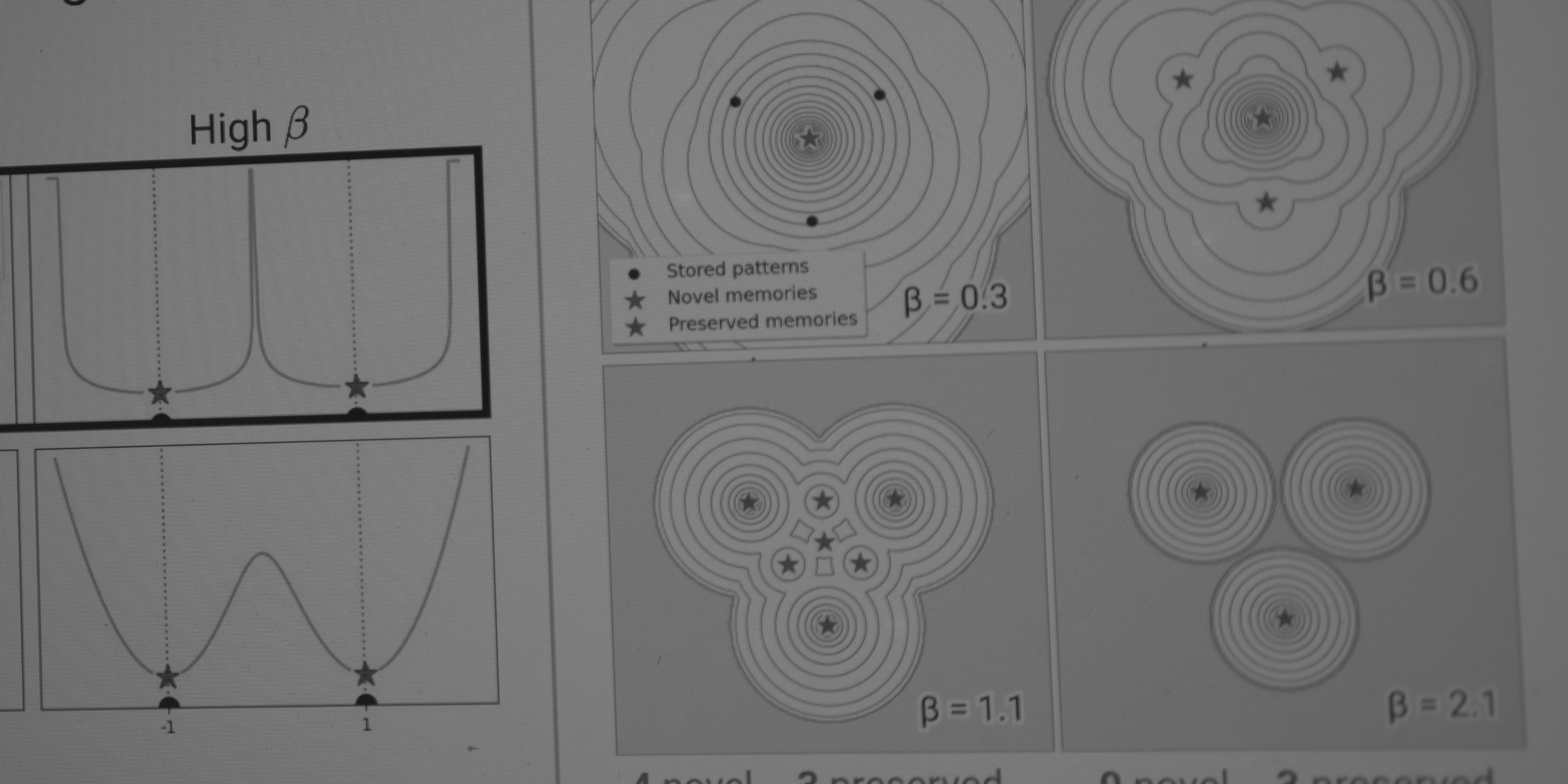
Demonstrating Dense Associative Memory on an In-Memory Computing prototype
Hopfield networks are enjoying renewed interest as simple dynamical systems that can store memories as attractors and recover them from noisy or incomplete inputs. Dense Associative Memories – or “modern Hopfield networks” – build on classical Hopfield networks and replace pairwise interaction with more expressive energy functions, leading to much larger storage capacity and richer attractor landscapes. Both forms of associative memory map naturally to in-memory computing (IMC): the network weights are stored in often novel non-volatile memory devices, and the dominant operation is the parallel matrix-vector multiplication performed directly on the array.
View Position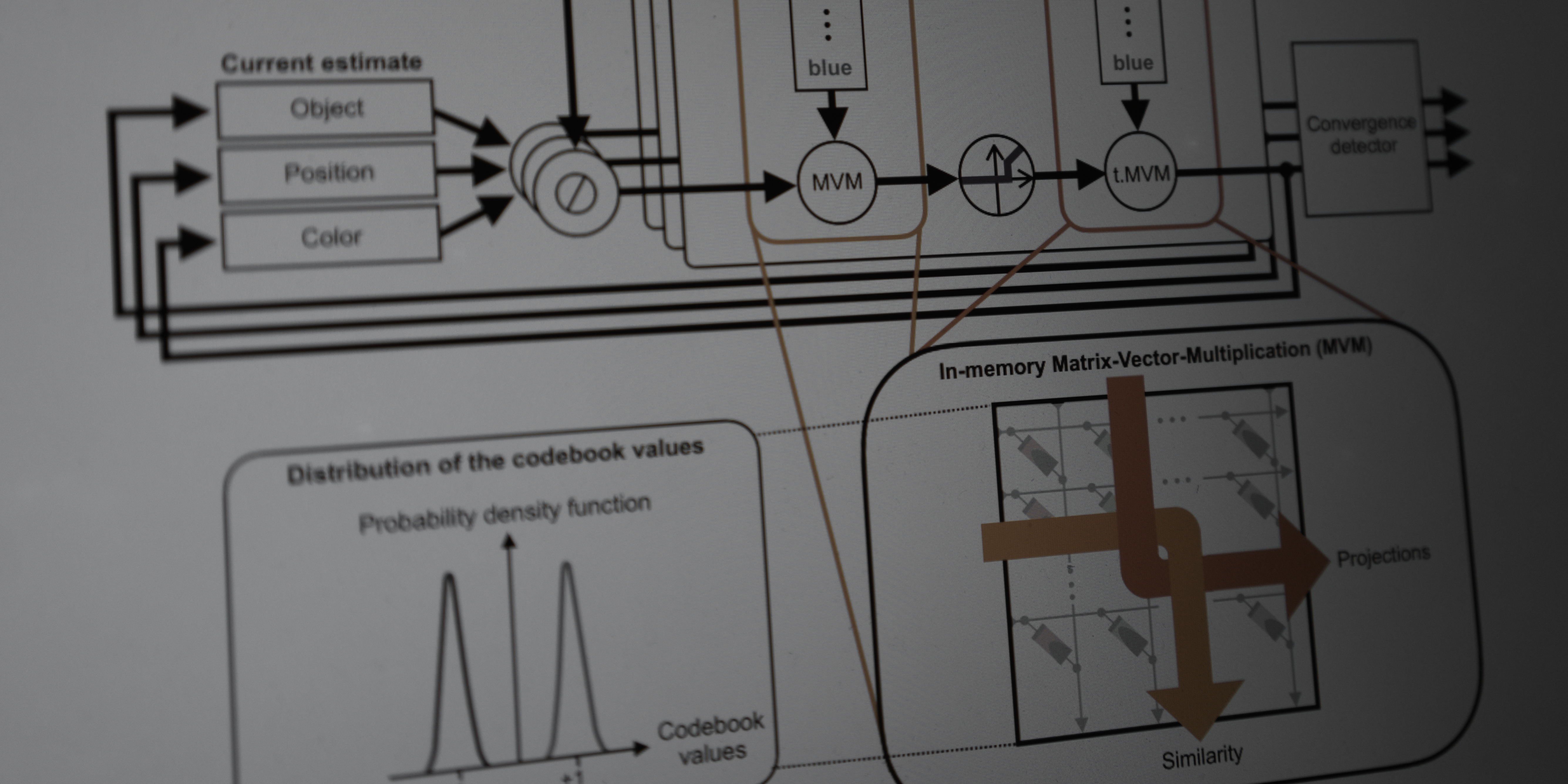
Dense Associative Memory for Resonator Networks
Resonator networks solve combinatorial factorization problems by iteratively refining candidate factors in superposition, and have shown strong performance for decoding compositional vector-symbolic representations¹. At the same time, Dense Associative Memories (modern Hopfield networks) provide attractor dynamics with significantly larger storage capacity than classical Hopfield models, suggesting a promising substrate for pattern completion inside resonator-style inference loops.
View Position
Time-based communication for In-Memory Computing
In the nervous system, neurons communicate through spikes. These spikes are elicited whenever a neuron’s membrane crosses an intrinsic threshold and in turn trigger a post-synaptic response on the receiving end. This event-based and temporally sparse nature of spiking communication is often associated with inherent energy efficiency gains and represents one of the core pillars of neuromorphic computation¹².
View Position